5. januar 2019

Arios (Arvos) Tauchkalkulator world time watch

I was lucky to find a specimen in almost mint condition of this impressive vintage watch from 1977. It has a very busy dial and not less than 5 bezels, 2 external and 3 internal. It has tachymetre scale, world time/gmt and 60 minute scale. It can also be used for calculating distance and speed. Furthermore it has both day and date. In the instructions for the chromed version - see more later - the watch is called ”Tauchkalkulator” which can be translated to ”dive calculator”.

The watch has three crowns. The upper rotates the GMT and Tachymetre internal bezels. The middle is used for setting time, day, date and winding. The lower crown rotates the 60 minute internal bezel. See a video here on Youtube.

My Arios (Arvos) from 1977 with black case and metal bracelet. Very impressive and contemporary 44 mm in diameter.
Please note that Arios is often mistaken as ”Arvos” because the hands in the logo can make it little difficult to read the name.

Click here if you want to know more about the history of the watch brand Arios and the Muros factory that owned the brand.


The black Arios 44 mm
The watch was launched in 1977 at the European Watch, Clock and Jewellery Fair, now known as Baselworld. The presentation read: Ideal for seaside holidays is this moderately priced diving watch, waterresistant to a depth of 50 m (150 feet ). Matt black metal case and bracelet. It features two inner bezels: one for diving times, the other for reading the time in major centres around the world.

The original metal bracelet seems almost to be painted and it scratches very easily. The watch itself has a more solid black coating.

Original image of the black Arios 44 mm from Baselworld 1977. Source.

Dimensions
Width w/o crown: 44,3 mm
Width with crown: 46,8 mm
Length: 49 mm
Depth: 13 mm
Lugs: 25,9 mm

Two versions
The watch came in a version with manual winding (maybe Ronda 1217) and another with an automatic movement (Ronda-Matic). The manual has ”1600” on the back of the watch and the automatic version has ”1601”.
Actually being a new watch with a mechanical movement in 1977 was a little out of place. At this point quartz movements was all the rage but maybe the mechanical movement was a way to keep the price down.
Here is

My manual-wound Arios Tauchkalkulator 1600 with five bezels and a lot of functions. 44 mm and only 13 mm thick.

Arios Tauchkalkulator with the original metal bracelet. A +40 year old watch in almost unused condition.

Arios Tauchkalkulator from 1977. Great presence.

The version with manual-wind movement has ”1600” on the back. 

The version with automatic movement has ”1601” on the back. Source.

On the inside it says ”Arios Ltd” and ”MRP SA”. The watch case was produced by MRP that still exists today.

Arios Tauchkalkulator with an automatic movement has ”Automatic” in orange below the logo on the dial. Source

Chromed version
Arios also made a version with a chromed metal case which was very similar to the black version. It has only two crowns and the bezels are a little different and less colourfull.
The size of the chromed version are width w/o crown app. 44 mm, height 15 mm and length 46,3 mm.
It also came in a version with a 17 jewels Ronda 1217-21 manual wound movement (594 on the back of the watch) and another version with a 23 jewels Ronda-Matic automatic movement (1594 on the back).
My guess is that the chromed version came before the black version. The silver/chrome version seems to be more common than the black.
Here is a video with some close-up shots of the watch and movement.

Arios Tauchkalkulator with a silver/chromed case, 2 crowns, 5 bezels and a manual movement.

Same Arios but with an automatic movement. It says "Automatic" on the dial and "1594" on the back of the watch.

Instructions!
From this post we have the original instructions for the Arios Tauchkalkulator.

The original instructions for an Arios Tauchkalkulator with two crowns.

Below the Instructions translated from German with Google.

- - - -

Instructions for use for your ARIOS dive calculator

The calculator starting from the outer ring, has 5 ring scales, by which you can make different calculations.

1. Distance calculation:
An airplane flies at a constant speed of 200 km/h for 1 hour 30 minutes.
Question: What is the distance traveled?
A: Set external turning arrow to 200. Read result at 1 h 30 min = 309 km.

2. Speed calculation
The required time is 4 hours 30 minutes. The covered distance is 315 km. What is the average speed?
A: Set 4 hours 30 minutes (black ring) to 315 km (inner ring). Read result below the marking triangle = 70 km/h.

3. Driving speed calculation: (time calculation)
The speed is 160 km/h. The distance traveled 400 km. In which time will this distance be covered?
A: Set the triangle to 160 and read at 400. Result = 2 hours 30 min.

This watch has two crowns, right. The lower crown is for winding (for non-automatic watches) and for pointing the hands and setting the calendar. The calendar quickshift allows you to easily bring the calendar from 1-31 by turning the hands back to the desired date. After 24 hours the weekday changes to the next day.

The top crown is for the operation of the inner rotary ring, on which there are 2 parts. The inner indicates the respective local time. The outer has a minute scale.

Local time determination: (world time)
Assuming it is 11:00 and you want to know what time it is in Mexico. Set the position Roma (Rome = Berlin) on the turning ring exactly at 11.00 o'clock. Then look for Mexico on the turning ring and find it at pos. 3 h. The minus sign means that it is now 3 o'clock in the morning. The plus sign, on the other hand, indicates that it is 3 pm at the location in question.

Minute Scale:
For this one finds for any sport use. At the kickoff of a football game e.g. set the arrow on the rotary ring exactly on the extended axis of the minute hand. In this case you are in the picture during the game over the remaining time to play. The measurability of the ring is limited to 60 minutes.

Tachymeter (rally time)
The prerequisite is that the length of the route to be measured is known and that the second hand is at 60 when starting the measurement.

- - - -

Hopefully you have found some useful informations here. Thanks for reading.

CLICK HERE - GO TO THE NEWEST POST ON THIS BLOG ABOUT LARGE VINTAGE WATCHES

30. december 2018

History of Arios (Arvos) and Muros watch brands

Arios was a brand from Fabrique d’horlogerie Muros, Erwin Triebold. The name Muros was officially registered in 1944 and Arios in 1952 (source).

Arios logo on a watch from the 1970s. ”Arios” is very often mistaken as ”Arvos” because the hands in the logo can make it little difficult to read the name.
Erwin Triebold was born in 1907 and founded the watch factory Muros in 1939 (source). The factory  was located in the Mumpf municipality which is part of Rheinfelden district in the northern part of Switzerland

Erwin Triebold’s older brother was Robert Triebold that earlier in the 1930s had started the Agon watch factory also in Mumpf. But that is a different story. (Read more about Agon here.)

From old ads it can be seen that Muros was not only the name of the factory but also used as a brand on watches. Often Muros used generic movements like FHF 26 (from Fabrique d'Horlogerie de Fontainemelon) but probably Muros also produced their own movement. A certain manually wound movement with 15 jewels can be found with the inscription ”Muros Watch Factory”.

Muros ad from 1947. The factory both made pocket watches, wrist watches and alarm clocks.

Muros ad from 1948. Muros was the company behind the watch brand Arios among others.

Muros ad from 1957.

Watch from the 1950s with movement stamped ”Muros Watch Factory”

Besides Arios and Muros the watch factory had a lot of different brands, e.g. Arnand, Calan, Chronorex, Cypress, Dorsee, Duke, Fambo, Galan, Gene Autry, Kantor, Lareine, Lima, Marco, Melano, Meleur, Murindis, Murindo, Muro, Murondis, Ontime, Pandan, Radax, Regional and Triebold. Some of these names can be found on watches, e.g. Murondis and Radax. But we don’t know how many of these brand names actually have been in use.

A Radax pocket watch from Muros watch factory. With a C. Crettiez movement.

A Murondis chronograph from Muros watch factory. With a Baumgartner 670 movement.

It seems that Muros in the late 1940s and the beginning of the 1950s also made character watches for the American market. In the bottom of the dial they had a gun that would move two times per second.

A Gene Autry watch from 1948 made for the American market by Muros watch factory.

A cowboy watch with a moving gun from 1952 made by Muros watch factory.

Ad from 1953 from New Haven Clock and Watch Co. The watches had "the exclusive moving part" and were probably all - or at least partly - produced by Muros watch company.

The oldest Arios watch I have found seems to be from the 1960s. Note the logo that is different than on the Arios watches from the 1970s after the brand got new owners.

Arios watch that seems to be from the 1960s.

At the height Muros employed up to 140 workers but already in the 1960s the factory fell into economic problems and it was sold in the late 1960s or in 1970 to the ”swiss family Schulthess”. Maybe this was the company ”Desco von Schulthess” that since 1946 had success with selling brands like Audemars Piguet, Heuer and Jaeger-LeCoultre in the far east and was becoming increasingly interested in the watch business.

According to Mikrolisk the Muros factory at the same time changed its name to Arios Uhrenfabrik AG. The new Schulthess owners must have wanted to focus on Arios and drop the other brands. Even though the brand Arios had been registered in 1952 it doesn’t seem to have been very much used by Muros previously and nearly all Arios watches that can be found has a clear 1970s vibe.

Examples of Arios watches

In 1970 the new Arios watch factory presented an inexpensive watch with day and date and a gilt or chromed case at the Foire de Bale / Baselworld. Source

In 1973 Arios presented this digital watch with a mechanical movement at the Foire de Bale / Baselworld.
It had both a digital display and traditional hands. Source

At Foire de Bale in 1974 Arios presented an "economical" model with brushed and buffed surfaces meant for both men and women. Source.

Another Arios digital watch from the 1970s. 39 mm.

Another Arios watch from the 1970s. 39 mm.

This Arios watch is very 1970s with three bezels: Tachymetre, diver and world time. It has a manual Ronda 1217 movement and measures 40 mm. On the inside of the watch case is stamped "Arios Ltd".

Arios multi-function watch presented at  Foire de Bale in 1974. App. 40 mm wide w/o crown and 45 mm length.

Same Arios as above.

My Arios Tauchkalkulator from 1977 with a black case and black metal bracelet. It has 5 bezels. Size 44 mm. Find much more info about this model and a similar watch from Arios here.

According to this source Arios Uhrenfabrik AG ended in 1990 and this source says 1993. Any way no more watches with the name Arios was produced. And then suddenly in 2005 the domain www.arios.ch was registered. The site claims that it is a Swiss Watch Factory with ”Watchmaker’s Quality”. The old logo is used again and even some new watches are presented. However these new designs doesn’t seem to have been put into production yet - UPDATE 2019: On Reddit a user has posted an image of this Arios, so it actually has been produced. 

This image of an Arios watch is from 2013.
CLICK HERE - GO TO THE NEWEST POST ON THIS BLOG ABOUT LARGE VINTAGE WATCHES

1. december 2018

The history of the Wittnauer watch brand

Wittnauer as a watch brand was born around 1880 – more than 130 years ago. It was a brand from the american company J. Eugéne Robert.

Wittnauer logo on a watch from the 1960s
I have the Wittnauer 2000 watch and this led me to investigate more about the brand and the people behind.

Jacques Eugéne Robert was born in 1833 in La Chaux-de-Fonds in Switzerland and emigrated with his family in 1845 to New York. Later he worked at a company that imported watches from Auguste Agassiz, one of the founders of Longines. In 1866 Jacques Eugéne Robert established his own watch importing company. He imported movements and watches from Swiss brands like Longines and Angelus.

The american watch importer J. Eugene Robert developed the Wittnauer brand

In 1871 the 38 year old Jacques Eugéne Robert married the 18 year old Lina Wittnauer. In 1872 Lina’s 16 year old brother Albert Charles Wittnauer also came to New York from Switzerland and began working for his brother in law, J. Eugéne Robert. Eventually two more Wittnauer boys, Louis Maximilian and Emile, and sister Martha Sophie, joined them in New York and began working for the company.

Albert Wittnauer became a close partner for J. Eugéne Robert in the management of the company and in 1880 Albert developed a new line of watches under the name ”Wittnauer”. The idea was to produce good, but affordable watches for the American market. The company established its own factory in Geneva. As watches from Switzerland were heavily taxed to protect the watch industry in USA, the actual assembly of Wittnauer watches was probably done in the United States.

In 1888 Albert Wittnauer took over the company and it was renamed A. Wittnauer Co.

According to Mikrolisk Wittnauer was officially registered as a brand in New York in 1893.

Albert Wittnauer developed the Wittnauer brand in 1880 while working for his brother in law, watch importer J. Eugéne Robert.

Wittnauer ad from 1893 in The Jewelers Circular and Horological Review
Source

Ad from 1899 in The Jewelers Circular and Horological Review.
Some of these gentlemen can very well be the Wittnauer brothers.
Source

In 1966 the company was a part of a antitrust case and from the hearings we have the most definitive source of information.

International aspects of antitrust: Hearings before the Subcommittee, 1966
A reliable source of information about the Wittnauer Company

The following are an extract from the book:

- - -

The first company to import "Longines" brand watches into the United States was started in 1866 by a Mr. Robert. The Robert firm was established at the same time as Compagnie des Montres Longines FranciIlon, S. A. was established in Switzerland, and became the exclusive distributor of "Longines" brand watches in the United States.

In 1888 Albert Wittnauer purchased the firm and in 1904 it was incorporated under the laws of New York as A. Wittnauer Company. In 1936 new interests bought out the Wittnauer family and the name was changed to Longines-Wittnauer Co., Inc.

In 1898 Wittnauer & Co. was organized in Geneva, Switzerland, and, after some intervening changes, incorporated in Switzerland in 1927 under the name Wittnauer et Cie., S. A. Wittnauer-Geneva has always been a wholly-owned subsidiary of Longines-Wittnauer. Other wholly-owned subsidiaries of Longines-Wittnauer are Vacheron & Constantin and Le Coultre Watches, Inc.

By 1946 Longines-Wittnauer's business consisted of importing into the United States "Longines," "Wittnauer," "Vacheron & Constantin" and "Le Coultre" brand watches and watch movements and selling completed watches under those brand names in the United States and elsewhere.

In 1946, at the direction of Longines-Wittnauer, Wittnauer-Geneva commenced the assembly of watches and movements which, with minor exceptions, it sold to Longines-Wittnauer. While the assembly of watches began as a pilot operation, it expanded and by 1954 its volume of production reached 80,000 watches, and the number of its employees grew from 25 to 30 in 1946 to 60 or 70 in 1954.

Wittnauer-Geneva did no other business than that described above except that for about two years it made sales of "Wittnauer" brand watches to retail outlets in Switzerland and exported a small quantity of "Wittnauer" brand watches from Switzerland to other countries.

- - -

As can be seen from these ads from swiss magazines in 1942 and 1948 Wittnauer watches were for some time also marketed in Switzerland.

Wittnauer & Cie S.A. ad from 1942. Source

Wittnauer & Cie S.A. ad from 1948. Source

Furthermore in the book there is this interesting paragraph: "Watches purchased from Thommens and Piaget were sold by Longines-Wittnauer in the United States under the Wittnauer trademark. Thommens and Piaget did not sell watches manufactured by them under the Wittnauer trademark to any person other than Longines-Wittnauer."

This underlines the fact that Wittnauer watches were often rebranded watches from renowned swiss manufacturers or pieced together with parts (movements, cases, dials) from various sources.

Further reading
If you want more info about the story and the people behind Wittnauer, see this article from Hans Weil which seems to be trustworthy and well researched.

Not least the story of Martha Wittnauer that were in charge of the company from 1916 to 1936 after the death of her brothers is interesting. As one of the few women in a management position in the watch business Martha Wittnauer became known as ”Miss Time of America”. She was 55 when she took over and 75 when the company was sold in 1936.

At one point around 2005-2007 Wittnauer (now owned by Bulova) themselves made a timeline with valuable information for their website. This is not active anymore but can be found here in the Internet Archive.

In 1994 was published a book about Wittnauer called ”A History of the Man & His Legacy”. It was written by american watchmaking legend Henry B. Fried. It is not available online.

Ownership of the Wittnauer watch brand, timeline
1880 The brand is born by the company J. Eugéne Robert (est. 1866)
1888 Company renamed to A. Wittnauer. Until 1936 the Wittnauer family owned the A. Wittnauer Company
1936 Hella Deltah Company takes over and the name was changed to Longines-Wittnauer Company.
1969 Westinghouse Electric Corporation purchases Longines-Wittnauer
1994 Wittnauer International Inc. is born. Now only with Wittnauer watches, not Longines.
2001 Wittnauer becomes part of the Bulova Corporation.


The company was established in 1866, not in 1867
In this ad from 1925 Wittnauer states that the company (not the brand) was established in 1866 which seems to be accurate in relation to other sources.

A. Wittnauer ad from 1925

Wittnauer ad from 1956 were the company celebrates it's 90th Anniversary

And then suddenly in ads from 1967 it says that the company was born in 1867. Maybe so they could celebrate a 100th anniversary when it was convenient for them.

Wittnauer ad from 1967

The relationship between Longines and Wittnauer
So what is the relationship between Longines and Wittnauer? Several sources take for granted that Longines owned the Longines-Wittnauer Company but there seems to be no proof of this. It seems merely that the watches from Longines were a big part of the success for the watch importing company and they decided to take advantage of this by renaming the company in 1936. Wikipedia states that Longines in 1950 bought Wittnauer – but again – this seems to be wrong. In the antitrust hearings in 1966 the distribution agreement between Longines S.A. in Switzerland and Longines-Wittnauer in USA is described. It is clear that they were two separate companies.


Very clear branding of Wittnauer as the affordable alternative
From the beginning Wittnauer was created as good quality, but cheaper alternative to the other watches from A. Wittnauer Co. like Longines and Vacheron Constantin. Most often the strong brand of Longines was used to also promote Wittnauer: ”Second best to Longines”.


Ad from 1947. ”Companion watch to the honoured Longines in the more moderate price field. The sturdy and dependable Wittnauer Watch”.

Ad from 1964. ”A very fine watch at a surprisingly modest price”.
Notice the Wittnauer Super Compressor called the "Scuba-Matic, All-Proof".

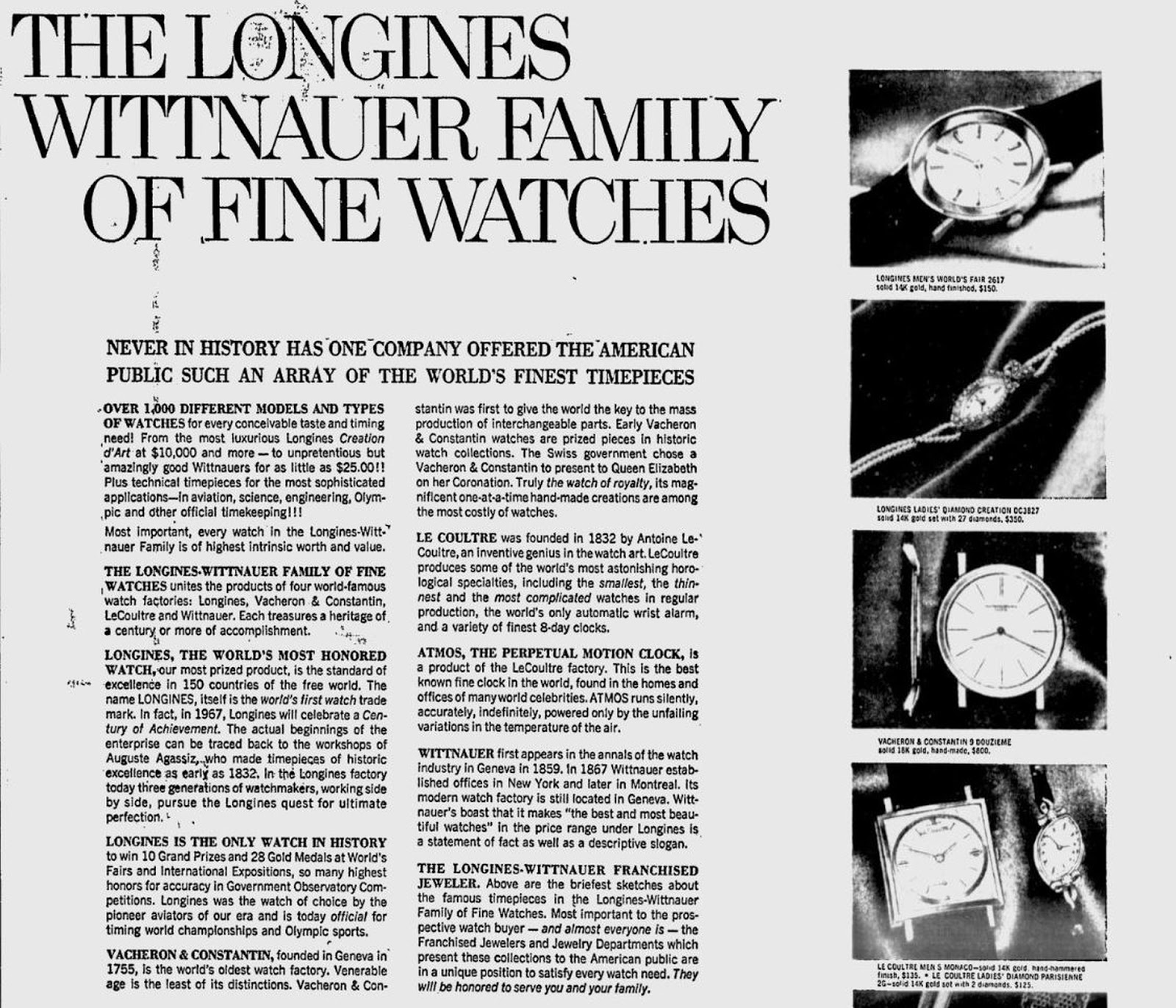
In this ad from 1965 all Longines-Wittnauer’s brands are presented. Wittnauer is said to have a modern watch factory in Geneva and is called ”the best and most beautiful watches – in the price range under Longines”

”Demand the best? Rather pay less?”.
Notice also the Wittnauer Chronograph 7004A in this ad

In 1967 Wittnauer introduced their version of an electric watch

A Wittnauer ad from 1970.
Notice the super delicious Wittnauer Chronograph diver in the middle.

In 1976 Wittnauer also had a range of boring LED watches. Inspired by the Pulsar watch introduced by Hamilton in 1972.

Significant watch models from Wittnauer
In 1912 John P. V. Heinmuller came from Switzerland to work for A. Wittnauer Co. as a clerk. He later became vice president of the company and from 1936 president of the new Longines-Wittnauer Watch Co. He was extremely interested in aviation and secured close ties between the company and flying pioneers like Lindbergh and Amelia Earhart. The company developed a complete line of navigation timing equipment, including aviation dash-board clocks. Probably in close association with Longines. Source and source.

Wittnauer also supplied wristwatches to the U.S. Army and in 1928 introduced the Wittnauer All-Proof watch. It was claimed to be the world’s first waterproof, shockproof, and anti-magnetic watch. Se more here.

The legendary Wittnauer All-Proof from 1928.

A Wittnauer All-Proof from 1961 with original box and papers.

Wittnauer was not only marketed as the cheaper brand compared to Longines. They even made watches that looked similar to famous Longines models

In the mid 1960s every brand seemed to have their own version of a dive watch with a Super Compressor case from Ervin Piquerez S.A. (EPSA). Longines had the 7042 with a caliber 19 AS movement. Wittnauer also made an EPSA Super Compressor watch. It was called the Scuba-Matic, reference 8007 and had a Wittnauer C11.KAS movement (a variant of the Longines cal. 501).

However Longines had the larger version of the Super Compressor case and with a size of 42 mm this is an extremely attractive model even today that has inspired the introduction of the Longines Legend Diver re-edition in 2014.

The Wittnauer Super Compressor cost $79.50 in 1966 – which is equivalent to $600 in 2017. Not a cheap watch.


Wittnauer Super Compressor, 36 mm, from the 1960s

The gorgeous Wittnauer 7004A with the red bezel resembled a Longines ref. 7981-3 Skin Diver from 1960s. Both measured 40 mm. The Wittnauer had a Landeron Calibre 248 movement (stamped Wittnauer 14Y).

A Wittnauer 7004A Chronograph. 40 mm.

A super nice Wittnauer Professional Chronograph 246 T called ”Scuba Roulette”.
It has a Valjoux 72 and measures 42 mm. Form the early 1970s. Wow.

And of course the famous Wittnauer 2000 and Witnauer 2002 watches from the early 1970s.
Click here to read to everything you will ever need to know about Wittnauer 2000 and its history.

Hopefully you found some interesting information here. Thanks for reading.

CLICK HERE - GO TO THE NEWEST POST ON THIS BLOG ABOUT LARGE VINTAGE WATCHES